
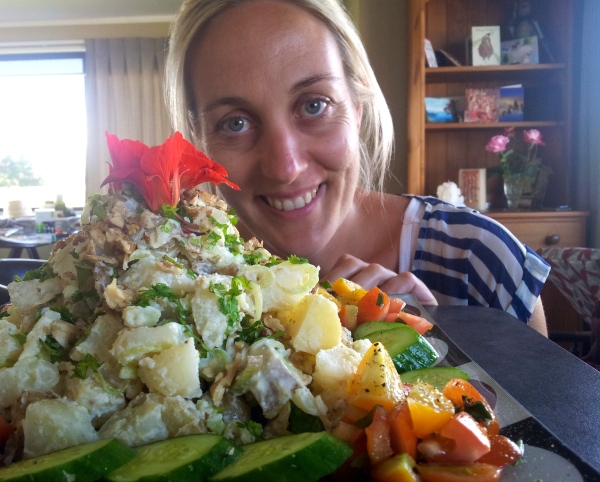
- My niece Sarah was my advisor when it came to decorating my potato salad mountain for a barbecue dinner with the family in Napier. I have discovered that potato salad is particularly good to eat if you are consuming bbq meats....more on why later

"Pick em up, pick em up hot potatoes...." Mart would chant and whistle on our back steps on Christmas day while carefully cleaning and scraping the new potatoes for lunch. Potatoes have been cultivated for 2000 years but my first connection with new potatoes was at Christmas time when I was a child. Every Christmas my great aunt and uncle, Nell and Mart, would arrive at our farm on Christmas Eve with freshly dug Jersey Bennies (new potatoes) from the Taieri Plains just outside Dunedin. To this day someone in the family is appointed to be "Marty" and prepare the new potatoes for Christmas lunch - and whistling is encouraged.
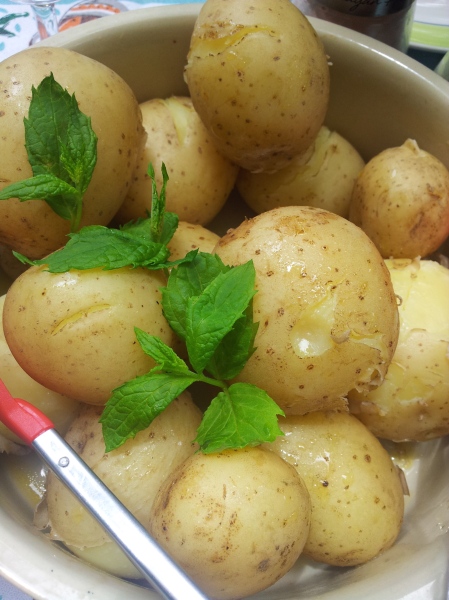
- Cooking Hint: For a big occasion when timing could be problematic then you can pre-cook half an hour before your guests arrive. Test with a fork and when nearly done quickly drain off the water, add some butter, take off the stove top and wrap in a towel...pot and all. The potatoes will keep hot for ages this way and the remaining heat will ensure the potatoes will be perfectly cooked when eaten.

You know if your new potato is freshly dug - just rub the skin with your finger and if it peels off it means the potato hasn't long been out of the ground. This is one of the main reasons you want to grow at least some new potatoes in your own garden.
New potatoes if really fresh are best simply prepared and presented. Gently boil with a sprig of mint and salt until tender and then for serving add butter or olive oil drizzled over them and a fresh sprig or two of mint for decoration. My friend Heather from Whangarei Heads recently presented her freshly dug new potatoes with the delicious addition of finely chopped preserved lemon and chopped parsley.
The Jersey Bennie is a variety that is specifically grown as a new potato. New potatoes are harvested as soon as they start the flower and if you are lucky this could be in time for Christmas. Although, if you are careful, you can do some "robbing" before you harvest. If you want potatoes that will keep over the winter then you need to allow them to grow until autumn and harvest once all the foliage has died away. These are called main crop potatoes.
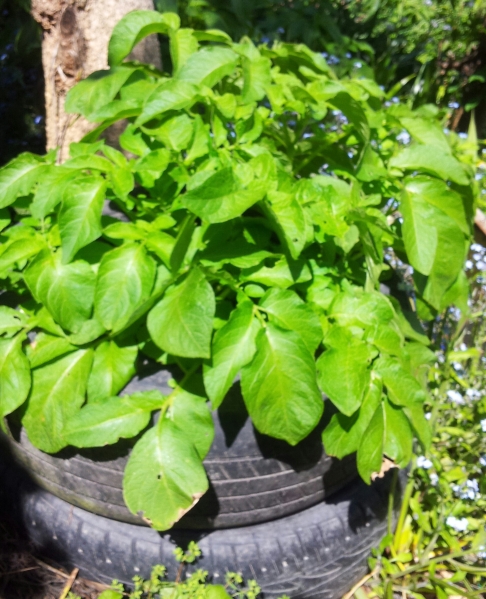
- Kerry grew her early Swift potatoes in tyres.

Funnily enough when potatoes were first introduced in Europe late 16th century from South America they were viewed with suspicion and considered "evil food". In Scotland people refused to eat them because potatoes were not mentioned in the Bible.
Well our Scottish ancestors may have had misgivings about this exotic import but in the Mackay family the arrival of new potatoes are so looked forward to that we have just had to make it competitive to see who can grow the best potatoes for Christmas? My sister Kerry easily won the potato growing competition in 2014 with her Swift potatoes.
Swifts (as their name suggests) are a fast growing new potato variety that can be ready for harvest in 60 days so are a good option if you are aiming for an early summer harvest.
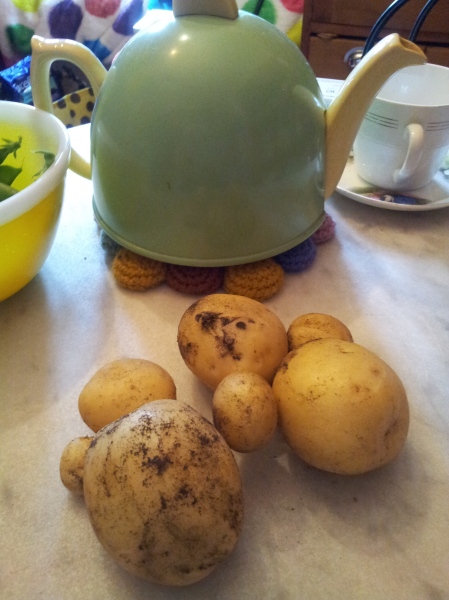
- Kerry was able to do some "robbing" of her Swift potatoes back on the 9th of December by gently lifting the mulch and picking a sample. This gentle robbing will allow the plant to continue to grow and once they start to flower you know it's time to dig up your new potatoes.

My entry into the Mackay potato growing competition was woeful this year. I have had to rely on our Sanctuary Community garden for our supply of fresh new potatoes.
The Community garden decided to grow Swift potatoes because of the short growing period and we were allocated on Christmas week 2 kilo bags of potatoes in return for the time we gave to the community portion of the gardens. Delicious the Swifts were too!
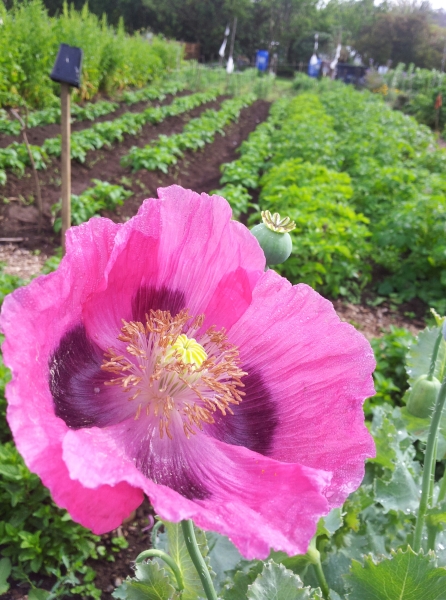
- Four rows of Swift potatoes in early November on the left and the earlier planted Maori potato varieties at Sanctuary Community Garden.

Before the Swifts three varieties of Maori potatoes were harvested as young potatoes at the gardens. Space is at a premium in our community growing areas so we grew new potatoes not main crop.
There is no one name in Maori language for the ancient potatoes grown here and the varieties are various as they have been selected and grown by families for generations. Taewa is one name and when translated means "foreigner" that hints at its origin. So where did Maori potatoes come from?
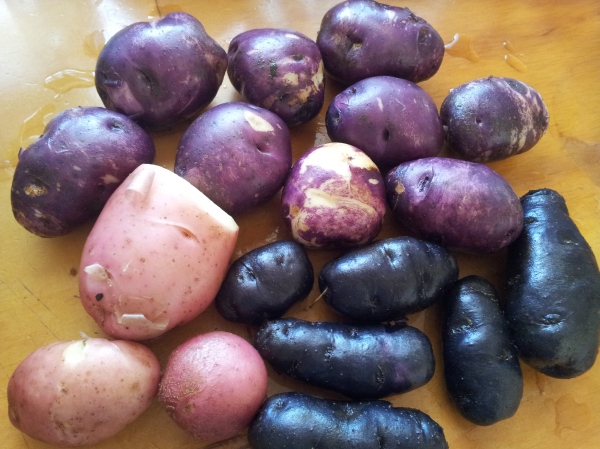
- Three varieties of Maori potato that were grown at Sanctuary Gardens: top Kowiniwini, left Maori potato and right perhaps the most common variety Urenika.

In the later part of the 18th century explorers, Captain Cook from England and Marion du Fresne from France, stopped long enough in New Zealand to set up gardens that grew potatoes and other European vegetables. Maori, unlike the Scottish a century earlier, soon realised potatoes were easier to grow and produced a higher yield than the Kumera (sweet potato) they brought from Polynesia. The arrival of the potato replaced the only other form of starch the fern root.
Potatoes were also introduced to New Zealand directly from South America via sailors and whalers. New Zealand Maori potatoes therefore have a much stronger genetic base making them stronger and more resistant to disease and fungal infections ... like that which caused the potato blight in Europe in the 1840s. In Europe all the potatoes actually came from a few potato varieties. So when the potato blight hit in Europe there was little resistance and the potato crops were devastated.
Not only are they more disease resistant they have a higher nutritional value.
Researchers at the Riddet Institute in Palmerston North have discovered that Maori potatoes have different attributes to modern potato varieties, which makes them useful for developing new food products. When testing four varieties of Maori potato against the modern potato Nadine they found,
"Overall, taewa have more antioxidants than modern Nadine potatoes (for example, 6-10 times more in the case of Tūtaekurī). Antioxidants are thought to protect cells from damage and may reduce the risk of cancer and slow the effects of ageing. Taewa are also rich in essential amino acids, minerals and anthocyanins. The skin of all the cultivars has higher protein, fat, minerals and dietary fibre than the flesh. All four cultivars showed significant nutritional advantages over the modern potato, Nadine." http://biotechlearn.org.nz
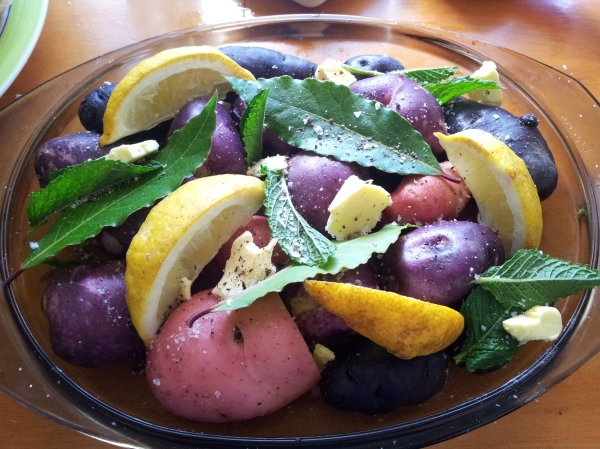
- The potatoes before being put in the oven. You can vary the flavouring - a favourite of mine is to put in unpeeled garlic cloves.

I have found Maori potatoes are far better cooked in the oven than boiled. They tend to disintegrate when boiled. I also like using the following method of baking with any new potato variety as I think it brings out the earthiness of the potato.
Place washed potatoes into an oven dish, slice half a lemon into segments and place on top, Add some mint leaves and I like to also add a couple of bay tree leaves. Season with salt and pepper and either dot with butter as I have above or your favourite oil. Cover with foil and cook in an oven for around 50 minutes at 180 Celsius.
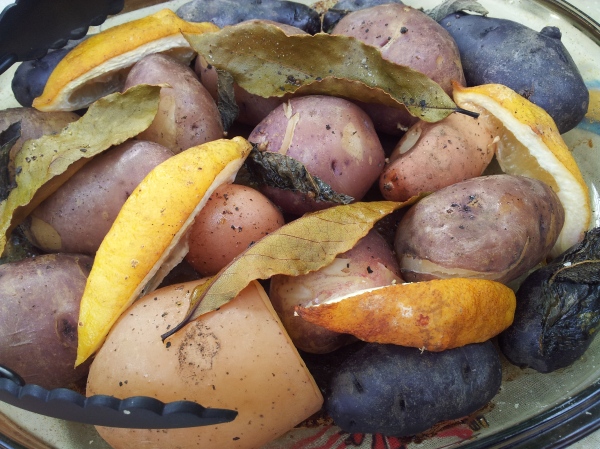
- The cooked potatoes do loose some of the intense colour - all except for the purple sausage shaped Urenika.

Cooking time varies depending on the number of potatoes and how they are stacked in a dish - single layer being quicker than layers.
I really enjoyed the Kowiniwini variety with its medium deepest eyes, and is distinctive with its yellow patches of skin. The potato has a purple-red skin but the fleshy is creamy white.

The variety simply called Maori potato is quite similar to other modern varieties in appearance and it has shallow eyes and a uniform round shape. The only real difference is the rough texture of the pinky-red skin.

The Urenika is probably the most commonly planted variety of Maori Potato simply because it's a real survivor as you will soon find out if you grow any in your garden. The purple skinned knobbly sausage-like tubers will persist in the ground for long periods and this is the potato that you can still find growing in the wild probably in old abandoned Maori occupation sites. The potato plants have purple stems and white flowers with grey in the centre of the petals. It is a very floury potato with purple flesh. If you keep them for a while before cooking they are less floury. The Urenika is probably similar to the Purple Congo that is cultivated in Australia and used by the Italian community to make gnocchi (potato pasta).

So for you gnocchi lovers out there why not try the Urenika.
I did have some leftover potatoes cooked this way and was pleased to see they did keep their shape when cut old into a salad the next day.
I have only recently learn't that cold potatoes are really good for you. I have never been a fan of potato salad but since learning that it is a very healthy option I have decided to perfect my potato salad recipe. Cold potato is especially good for you if you are eating red meat and a barbecue is probably the setting where you are most probably going to find a potato salad lurking.
So what is the difference between a hot potato and a cold potato?
When a potato cools down much of the potato starch turns into "resistant" starch. Resistant starch is not digested in your stomach or absorbed in the small intestine but passes into your large intestine, where it becomes food for a host of beneficial bacteria ... these starches will also line and strengthen the walls of the colon.

The trouble I have with potato salad is that it's such a boring unappetising colour so I decided to make a potato salad mountain and decorate it with other salad vegetables for a recent family barbecue.
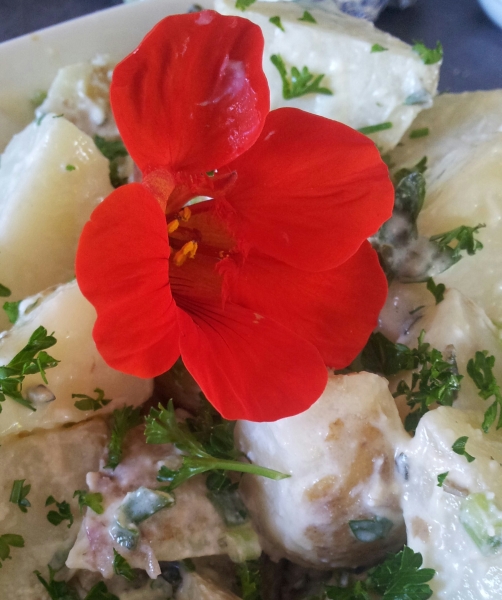
- Green additions can be any herb such as parsley, coriander, basil or chopped chives. A nasturium always adds colour and a feel of summer. This variety is called "Empress of India" - it is supposed to be red but its a very dark orange. The good thing about this nasturtium is that it has a compact habit so is good for those that don't have room for the rambling standard nasturium.

For a quick dinner I wouldn't go to these lengths but I would always have some green in the dressing and pop on a colourful edible flower. At our barbecue young Julie who is 6 really loved the peppery flavour of the nasturtium.
Cook the potatoes ahead of time so they can cool down before eating. They don't need to be chilled but do need to be cold. Cook them with their skins on as it helps keep them together and besides a lot of nutrients in potatoes are in the skin.
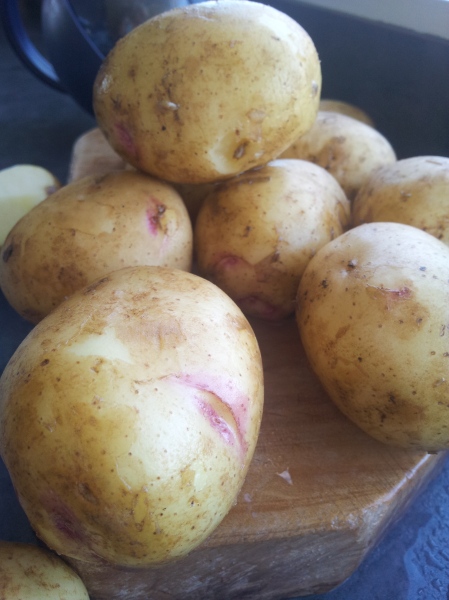
- Osprey potatoes I purchased at the Tauranga Farmers Market. I am always keen to try a different variety of potato and these Osprey with their pink eyes were intriguing. I later found out that the soft moist texture makes them an ideal potato salad candidate.

There are two camps of opinion when it comes to how to dress your potato salad - whether you use an oil and vinegar based dressing ... or a creamy dressing. Around the same time that I discovered cold potato was good for your gut health I was given some Kefir grains to produce the fermented milk product Kefir that is also great for promoting gut health. I will follow up with a posting dedicated to kefir and if you haven't got kefir on hand you can just use yoghurt for this dressing.
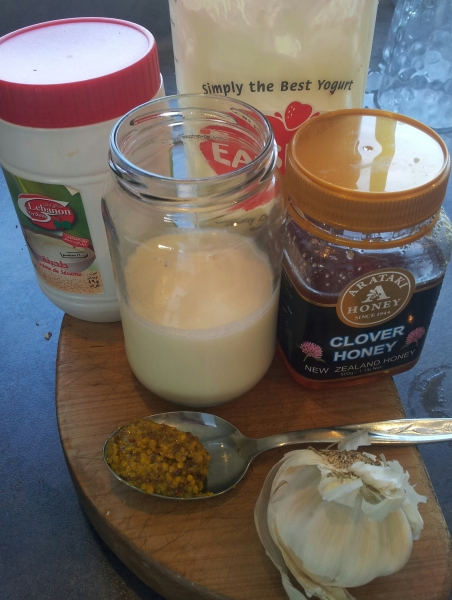
- I bought the Arataki clover runny honey en route from Tauranga to Napier as I thought it would come in handy for the Christmas catering and it has been great for sweetening the kefir and for dressings.

Kefir, Yoghurt and Mustard Dressing
One cup of Kefir (you can just use yoghurt instead)
3 Tbsp of Yoghurt
2 tsp Tahini paste
one garlic clove crushed and made into a puree in some salt
1 tsp grainy whole mustard
1-2 tsp of honey - add one at a time and taste
1-2 Tbsp of your favourite oil.
Shake and mix - taste and see if you need more honey. Kefir is tart and acid so you may need 2tsp of honey if using kefir or a particularly tart yoghurt.
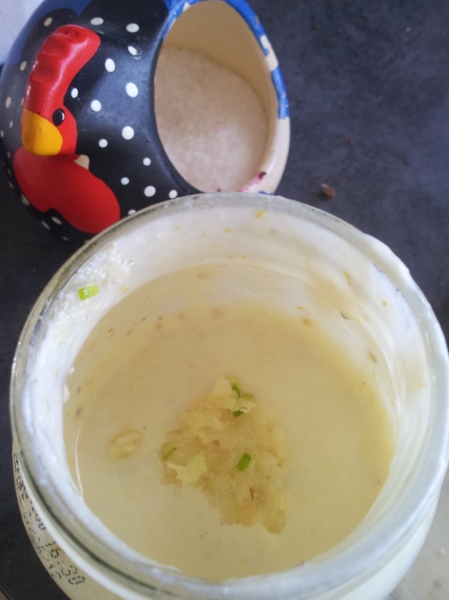
- Here I have just added the garlic that has been crushed with salt to become liquid. This is optional but I love garlic and especially now that new season's garlic is around.

The tahini is the thickening agent as kefir is the consistency of cream - just using a tsp or two will not give you a dominating flavour of sesame. I add yoghurt to get a creamy taste and texture. If using all this dressing in one go then you can also chop in herbs. To give an aniseed flavour, chop up a small amount of tarragon (no more than one sprig). Parsley is a great addition and you can use lots of parsley. I have also used fresh coriander and a good pinch of ground cumin. Flavour it however you like. If you are using just yoghurt you may wish to either grate some lemon zest or add a squeeze of lemon to give it more zing.
This dressing can be used for any salad ... not just potato. It's a healthier option to replace a mayonnaise dressing and everyone in the family enjoyed it in combination with the potato.
The Maori gardeners became excellent cultivators of the potato and soon began trading their surplus potatoes to our growing cities and to Australia. The early European settlers would have relied on these potatoes for food until they could establish home gardens. In the US Thanksgiving remembers the kindness of Native Americans who provided starving settlers with food. Pumpkin and turkey are part of their Thanksgiving celebration meals, but perhaps in New Zealand we should give thanks to the early Maori gardeners and the potato affectionately called "the spud".
Most of the information on the history of the potato in Europe and the Maori potato here was from the published work of "Nga Riwai Maori - Maori Potatoes" by Graham Harris and Poai Pakeha Niha" funded by NZ Open Polytechnic.


