Thursday, 5 March 2015

The Scallopini Challenge

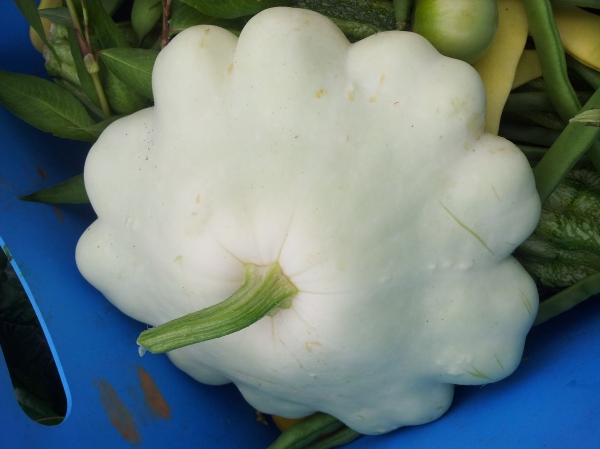
It's an Italian.  Around the world it's known as pattypan squash, granny squash, sunburst squash or custard marrow. In New Zealand it's called Scallopini.
20150208_181313
This rather perfect looking vegetable in Birthe's basket at Sanctuary Community Gardens caught my eye and my immediate thought was of a flying saucer.
It's really just a fancy shaped zucchini from the summer squash family Cucurbita pepo.  
20150304_124845-1
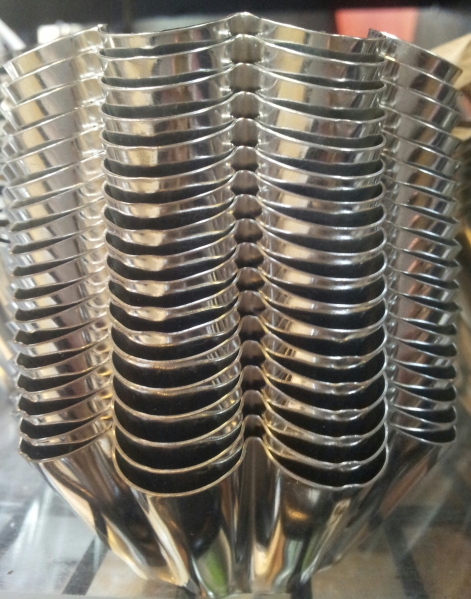
A stack of brioche tins at Milly's Kitchen shop, Ponsonby.
The nickname Pattypan squash came about because of the scalloped shape that resembles the similar shaped cake or brioche pans.
On a recent visit to our Sanctuary Community Gardens I was handed a cluster of scallopini and a challenge.
Trevor asked if I could come up with a recipe that would showcase the scallopini.
20150226_111151
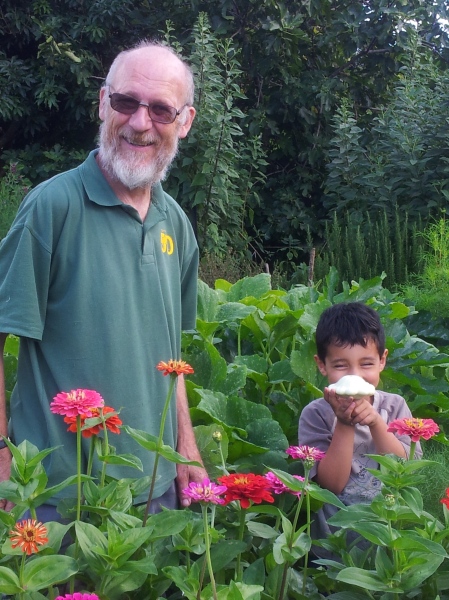
Trevor suggested I get a shot of Beau with the scallopini patch behind him to show how large they grow. Trevor Crosby (left) and Beau right with a scallopini at Sanctuary Community Gardens.
My grandson, Beau, told me "Trevor knows a lot of things".  I have to agree. It's thanks to Trevor's knowledge and caring for the scallopini and the gardens in general that there is such an abundance for us to share.
Scallopini can be used just like courgettes or zucchini;  thin slithers raw in salads, sautéed in garlic and fresh herbs and put together with pasta and parmesan cheese, or as an ingredient in a ratatouille or vegetable stew.
20150224_155204-1
I decided baking them would be the way as their signature scallop edges would be retained.
20150224_182610
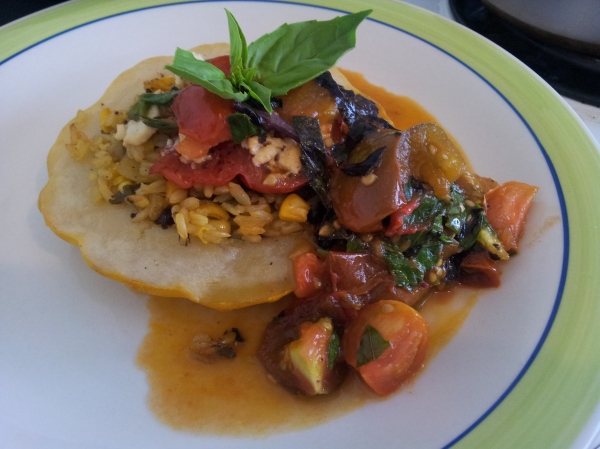
The dish that was the outcome of the challenge that I have called "Trevor's Spicy Rice Scallopini" with tomato and basil sauce.
I started the challenge by looking through my recipe books... then decided just to make something up with the ingredients I already have in the pantry.
20150224_155635
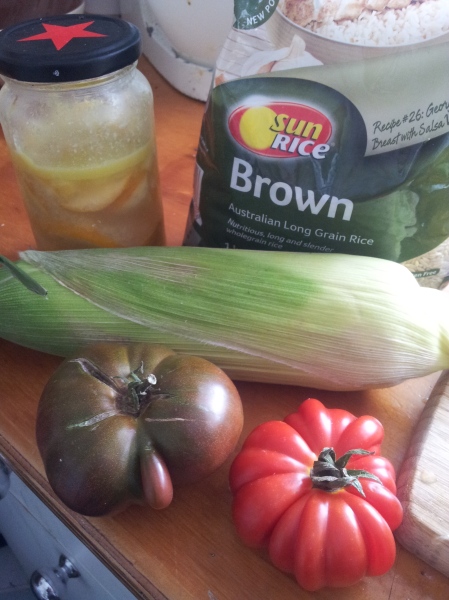
I had brown rice, corn, preserved lemon and a couple of Italian heritage tomatoes from the gardens.
Rice was to be the base for the stuffing so a cup of brown rice was cooked in salted water (it takes ages compared to white rice to cook but you are rewarded with a nuttier flavour and healthy fibre.)
While the rice cooks, saute onion until soft.
20150224_161207
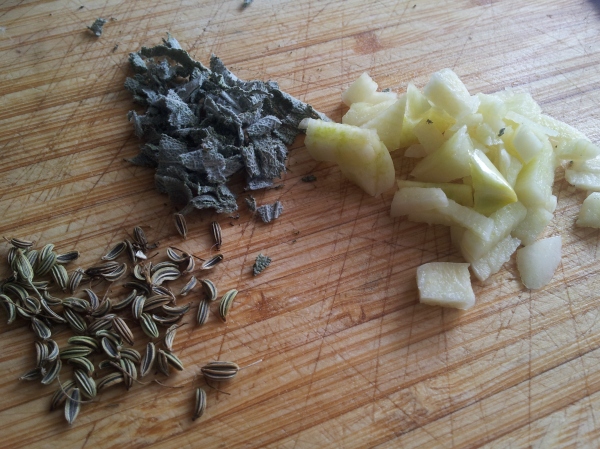
Bottom left: fennel seeds that I gathered from the gardens and dried myself, Centre: sage that I also picked and dried but you can use fresh instead, and Right: one of our garlic cloves grown at the Gardens.
For flavourings I used about a teaspoon each of fennel seeds, dried sage and one large garlic clove chopped.
20150224_161452
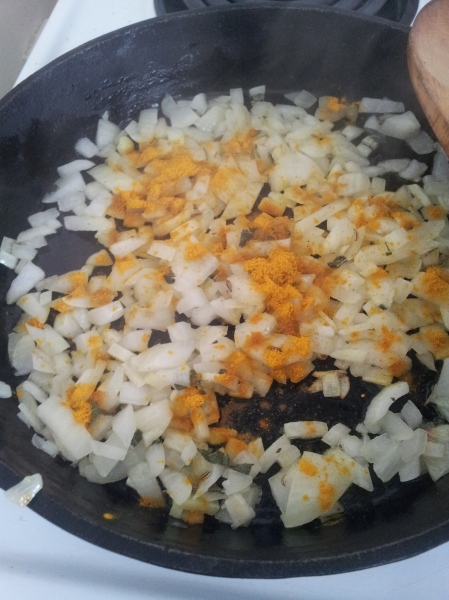
Whenever I can I add turmeric to dishes because it is so good for you and adds colour.
I added these to the softened onion along with 1 tsp of turmeric.  I wanted to use preserved lemon so decided this dish would lean towards the middle east in flavour.
20150224_161644
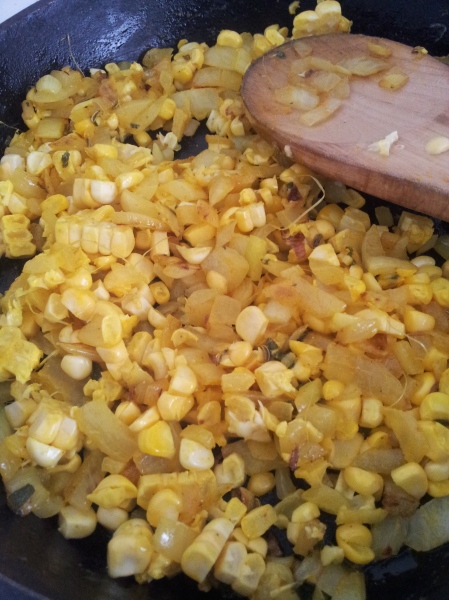
You could use red peppers instead of corn to give colour and something sweet. You can also just use canned corn kernels.
I had one corn cob left and knew this would make my scallopini attractive to Beau who loves corn. I cut the cobs from the uncooked cobs by sliding a knife down where the corn meets the husk. There were quite a few stringy fibres that I plucked out before adding to the spiced onion mix. Instead of corn you could use red peppers and a chilli if you want to add some heat.
20150224_162013
Next I thought about adding some nuts.  Almonds would be a delicious addition but on this occasion I  use seeds - 1/4 cup of sunflower seeds in recognition of the great display we have of sunflowers at our gardens.
20150217_091710
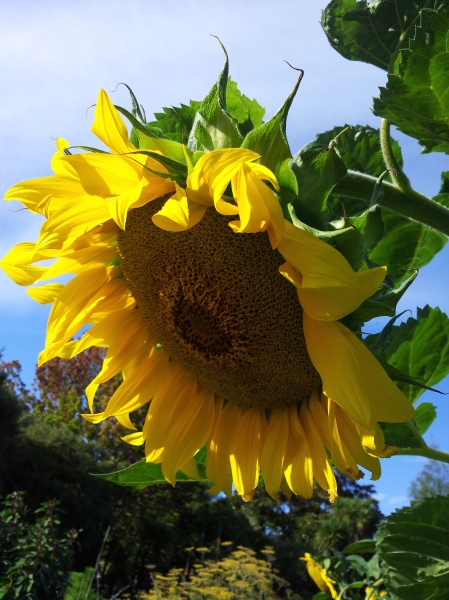
Sarah who planted all the sunflowers named this particular sunflower "Ernest"..because he stood the tall and proud delaying flowering until the week of the Auckland Heroic Garden tours when our community garden was on show. Ernest has been selected as the seed provider for next year's crop.
20150224_162216
When using preserved lemon don't salt your food until you have added the lemon because it's very salty and I found I didn't need to add any extra salt.
I cut up some slices of preserved lemon (rind, flesh and salt altogether).
20150224_162437
In keeping with the middle eastern theme I added 1/4 cup of currants to add something sweet.
20150224_162829
I mixed the drained cooked brown rice with the spiced onion and corn mix, and had a taste. It was delicious but I felt it just needed one more spice.
20150224_163205
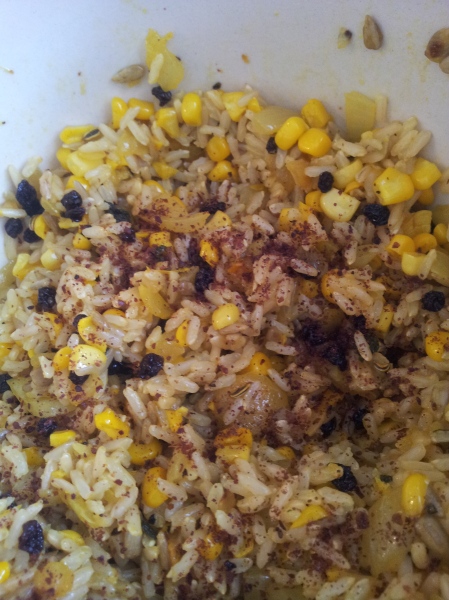
Sumac is native to Iran and is a reddish purple. Sumac comes from berries that are dried and is usually sold ground.
Sumac or sumach has a fruity astringent taste that is used in middle eastern cooking especially sprinkled over rice, salads, fish and stews.  A good sprinkling gave the rice the flavour I was looking for.  
20150224_155825
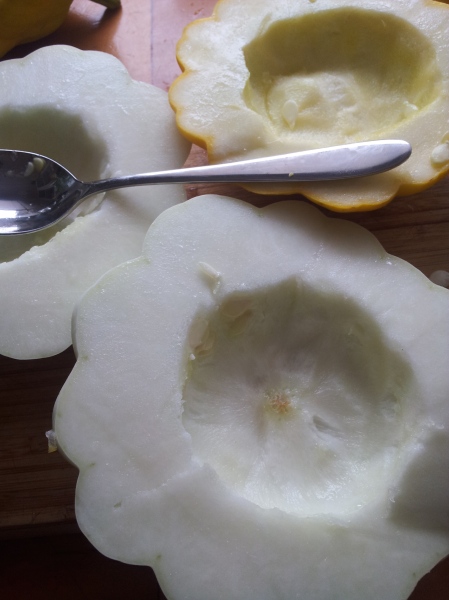
Scallopini has a nutty flavoured flesh denser than zucchini and they keep for longer in the refrigerator.
At last the scallopini come onto the scene. They are easy to cut in half and with a spoon just scoop out the seeds to make a little dish for the rice filling. The scallopini I chose were the size of a saucer.  They do grow larger and Trevor says they don't get stringy like marrows even at this large size, but they are at their best when not too large. For me the scallopini the size of a saucer are a good size for stuffing.
20150224_163425
The seeds from one packet turned out plants with yellow and creamy coloured fruit. For me I gravitate to the cheery yellow ones. Kings Seeds have a variety called Squash Sunbeam F1 that has good resistance to powdery mildew.
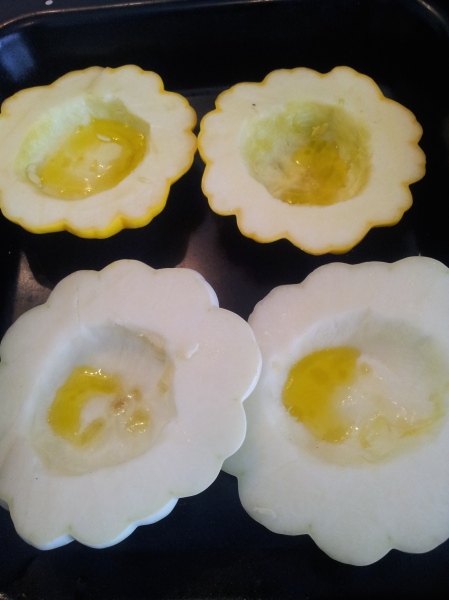
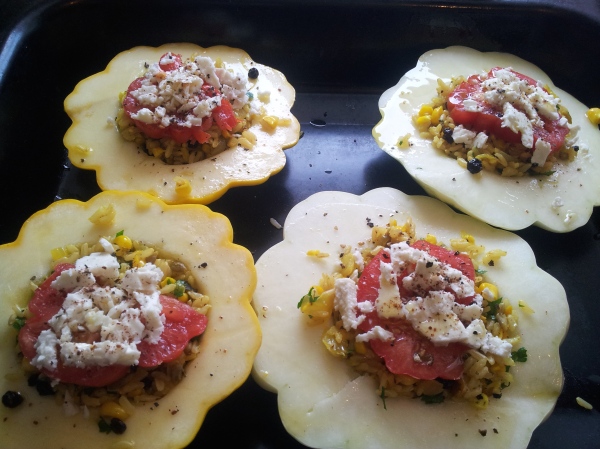
I add some oil and with a brush sealed the scallopini flesh. The cavity is then filled with the mix then add thick cut slices of meaty tomatoes on top, (heritage Italian tomatoes also from the gardens) .
20150224_164734
The final touch is a little crumbled feta with another sprinkling of sumac.
20150224_164721
I place them in a large oven tray and cover with foil to cook at 180C for at least an hour.
20150224_184600
The flesh is nice and juicy but to add more moisture and a luscious red, I made a tomato and basil sauce by melting butter and quickly frying two of those lovely beefsteak tomatoes, chopping in basil towards the end of cooking and seasoning with salt and pepper.
With the amount of rice mix I had I could have stuffed twice as many scallopini than I did. This mix could easily cover 4-6 whole scallopini (up to 12 halves).  It's also good as a rice salad.
Trevor's challenge has been fun and I hope he enjoys the recipe.  I have decided to call the dish Trevor's Spicy Rice Scallopini.
Focusing this week on scallopini has delayed my post about kefir that I have been promising to write about.Kefir can wait but not so an abundance of scallopini - just like courgettes they are only in plenty at this time of the year.  This recipe can be used for any squash, courgette or pumpkin.
Never fear kefir is coming up next.  I have been experimenting with it and have discovered many ways to incorporate it into our diet. There may even have to be a couple of posts dedicated to this gutsy topic.

I have moved my blog to www. Jeannieskitchen.me


Friday, 23 January 2015

Whangarei Heads, buffalo cheese and the promise of scallops


20150117_181828
Green salad, tomatoes and Buffalo Labneh with a coriander and rocket pesto dressing topped off with Amethyst basil.

I can’t believe that just a few days ago I was in coastal Otago.  Now at the other end of the country we are spending the weekend in the balmy and beautiful Whangarei Heads.  However, Whangarei Heads does remind me a little of home on the Otago Peninsula.
It was a perfect way to complete our summer holiday with our friends Heather and Martin soaking in the stunning views, listening for the sound of kiwi at night and swimming in the clear blue harbour with the company of Kai, a rock diving Golden Retriever.

20150117_165227-1
Kaiteremoana (loosely translates to ‘navigator’) aka Kai is not allowed to dive for rocks because it hurts her ears. She watches out to see when no one is looking and sneaks the odd dive. The rocks are then buried in a big hole in the sand.
pic20150118124048
Views from the Mount Manaia walk that took us two hours return. Lots of steps but the views are worth the puff. Top photo: view from Mount Manaia looking down towards Urquharts Bay at the end of the Peninsula where we stayed. Centre left: lots of hebes in flower on the walk; Centre right: me and one of the large Totara’s on the walk. There were also large Kauri trees. Bottom left: lichen growing on the walls glistening after a good rainfall the night before. Bottom right: an excellent  DOC track. I heard that there were 400 steps included in the track…too many for me to count.

I discovered it’s not only the shape of the land that is familiar to Otago Peninsula. This area has had its fair share of Scottish early settlers too. Unlike Otago and Southland, Scottish settlers here didn’t come directly from the Highlands but via Nova Scotia, Canada. Compared to Nova Scotia I think the Whangarei early settlers must have thought they had arrived in Heaven with the warmth and lush growing conditions of Northland. Little touches of Scotland remain as every New Year’s Eve in Urquhart’s Bay the sound of bagpipes welcomes in the New Year from a boat moored in the harbour.
Heather is a wonderful cook.  I wanted to bring something delicious and new for the weekend, so we battled with the Auckland traffic to stop in at the Matakana Village Farmers Market.  There I met Jo from Whangapiro Buffalo Cheese Company who is  passionate about buffalo cheeses and proudly showed photos of the latest arrivals to their herd. The Whangapiro buffalo stock came from Australia but originated from Italy.

Screen Shot 2015-01-18 at 2.23.24 pm
This photo is from Jo’s Facebook site. Aren’t they so cute with those large soft ears? Apparently their moos are different from other calves – more like duck calls. Click on the link above to learn more about Buffalo and the cheese produced from their milk.

We tried the Yassou Buffalo Haloumi and the Grado Buffalo Milk Labneh (soft balls made from Buffalo yoghurt coated in herbs and stored in a jar of oil). Both were delicious so we went onto Whangarei with both cheeses.

20150118_143154
Grado is named after an Italian village. Labneh is made by straining yoghurt through muslin until the whey separates and the remaining thick cream can be fashioned into balls. You can also do this with cows milk yoghurt but the buffalo milk is supremely rich.

That night I offered to make the salad.  Heather had assembled a lovely selection of small green and purple coloured lettuce, large leaved rocket, cucumbers and a good quantity of coriander.
I cut the cucumbers length wise and scooped out the seeds dicing into 1 cm pieces.  This is to avoid the salad becoming too soggy.
pic20150118164751
If I wanted to use tomatoes I could go out and select them.  No need to wash them as we had just received a warm downpour courtesy of Mother Nature. I simply cut them up and seasoned well with salt and pepper before adding to the salad.
Next I cut up three Buffalo Labneh balls and dotted them on top of the tomatoes and salad greens.
Now all these freshly harvested greens,  tomatoes and cheese could just have a simple dressing, but I felt with so much coriander and rocket on offer I could make a pesto dressing that would add a real flavour punch.

20150117_180038
Using a mortar and pestle is more work than using a stick blender to make a pesto but the oils of the herbs seem to combine better if crushed by hand and the end result is quite a different consistency to that of the machine blended pesto.

Using a lovely large stone mortar and pestle I first crushed a large clove of mild flavoured garlic with rock salt.  Crushing the garlic with salt makes it into a garlic slurry. Add a good handful of coriander and 2 or 3 rocket leaves slowly adding olive oil to ensure a paste develops.
Now for the nut component: for pesto you can use pine nuts, almonds, hazelnuts, walnuts and even peanuts but Heather suggested I use macadamia nuts.  As these nuts are grown in Northland I decided they would be perfect.  Their mealiness and mild flavour would be perfect with the strong flavours of coriander and rocket. I found them tricky to crush whole, so I took them out and cut them up before working them into the paste with the mortar and pestle.

20150117_180520
Heather has developed a short cut method of preserving lemons. I am keen to try this myself so will feature this in a future posting.

I usually finish off a pesto with a squeeze of lemon.  Lemon also serves to retain a bright green colour in the pesto.  As we didn’t have any lemons,  I used one slice of Heather’s homemade preserved lemon.
This turned out to be a great addition.  I really enjoyed the preserved lemon flavour.
20150117_180957
I set aside a couple of tablespoons of pesto for the dressing and put the remainder in a bowl for everyone to enjoy before dinner with crackers.
For the dressing I dilute the pesto with olive oil.  Always taste at this point.  You might want to add a dash of vinegar but the preserved lemon made the dressing acid enough for this salad.
20150117_181828 - Version 3
Just before serving I drizzle the pesto dressing over the salad.  Even though coriander is the major flavour for this salad I couldn’t resist using some amethyst basil from the garden and placed some tiny whole cherry tomatoes in and around the cheese.
pic20150118130711
The salad complemented a Maori potato salad with chopped spring onions and local extra virgin unfiltered olive oil from Pataua Olive Grove, and the sweet and juicy sweetcorn purchased from a local roadside stall.  Martin was in charge of producing the hot smoked salmon making this meal truly memorable.
Talk of scallops in the bay became a challenge for Peter.  It was decided tomorrow when the tide is right he and Martin would attempt to free dive for scallops.

pic20150118133412
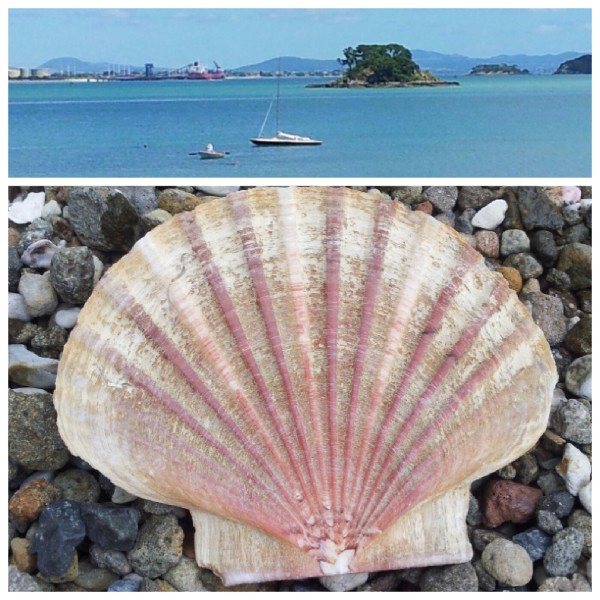
Above: Heather in the row boat while Peter and Martin diving nearby. Below: Scallop shells are easily spotted on the beach.

The promise of scallops for lunch depended on catching the tide at the right time and Martin and Peter being able to free dive deep enough.  It wasn’t looking good. Then along came young Rolf who is an excellent free diver and he saved the day harvesting enough scallops for us to share over lunch.

20150118_145736
Rolf with the scallops that were the centre piece for our lunch.

I asked Heather to show me her favourite way of cooking scallops.

20150118_145359
Heather on my question picked up a scallop and popped it into her mouth raw. I wasn’t quite quick enough to catch the action on camera but did catch the cheeky satisfaction.

She has tried a number of ways of cooking them but prefers this simple and quick method that showcases the flavour of the fresh scallops.
20150118_145332
Melt a dollop of butter and add chopped garlic (how much is up to your preference) and  a couple of kaffir lime leaves sliced.  Saute slowly so as not to burn the garlic and butter. Turn up the heat and throw in the scallops.
20150118_145450
The scallops are cooked and taken off the heat when the colour of the muscle goes from slightly translucent to creamy white.  They take less than 5 minutes but it depends on the condition of the scallop and how full the pan is.
20150118_145831
The finishing touch was some fresh coriander scissored on top of the scallops at the table. Yum… they were the most delicious scallops I have ever eaten.  I think they were so good because they were alive half an hour before we ate.
How privileged we are to still be able to harvest a meal from the sea.  We only got a couple of scallops each but then a little of something lovely is sometimes more appreciated than a lot. Besides we had plenty of fresh salad vegetables and the rest of the Buffalo Labneh balls to add to our lunch time feast.

20150118_150754
The lunch table, left is Peter, centre Martin and right Rolf.

Martin and Heather live in a beautiful part of Northland and are a major force in the local community based Backyard Kiwi action group restoring kiwi numbers in the surrounding bush on Whangarei Heads.
Backyard Kiwi aims to have kiwi thriving on Whangarei Heads for the grandchildren of today’s residents.  Managed by the Whangarei Heads Landcare group and through working with local residents this project has been so successful that the aim to have 1000 kiwis living on the peninsula by 2020 looks like it will be exceeded. This has been one of the most successful kiwi breeding operations in the country and it has been completely reliant on the skills and passion of local residents to save their kiwis.

Screen Shot 2015-01-19 at 3.04.03 pm
The Backyard Kiwi website http://www.Backyardkiwi.org.nz has lots of photos and good stories about the kiwi of Whangarei Heads. The kiwi drawing that is the mascot of Backyard Kiwi was created by Heather Hunt and if you drive on the Whangarei Peninsula you will see her kiwi road signs made to shine at night to remind residents kiwis are out and about and could be on the road.

Heather’s an artist and she generously allowed me to use the image that she painted of her Swift Whip eggbeater for my blog.
sm-web-Egg Beater [1] © Heather Hunt
She illustrates children’s picture books and her drawings have really captured the personality of the kiwi. You can see her work at this link Heather Hunt. 

w-15.01.18_6650 - Version 2
Photo by Heather Hunt and art direction by Marita Hunt.

In this beautiful corner of New Zealand we ended our weekend with a long swim followed by sitting on the beach watching the sunset, sipping a refreshing Pinot Noir Spritzer (a mix of wine and soda water) and munching salty potato chips in the company of Heather, Martin, their daughter Marita and Kai the dog.

Thursday, 15 January 2015

Shag Point Summer Salad


Imagine, freshly caught blue cod and an even fresher salad while watching the sun set over an expansive view of the coastline and the Pacific Ocean.
20150113_182831
Courgette, carrot and walnut lettuce salad with a final flourish of tart black currants.
I was lucky enough to have this experience when visiting my friend Kate in the small coastal village of Shag Point in Otago. It’s only 50 minutes drive north of Dunedin and I can’t believe this is the first time I have stopped and explored this remarkably beautiful piece of coastal Otago.
pic20150115011259#2
Top: the view from the bach window. Bottom left: the caravan permanently resides with a similar view and accommodates extra guests. Bottom right: fur seals are rock loungers as you walk around the rock platform.
Kate and Peter work and live in the Waitaki Valley (I profiled them in my posting Waitaki Valley Honey with Plums and Basil in March 2013) and purchased their Shag Point holiday home last year.  They enjoy the coastal life whenever the opportunity arises. Peter is a keen fisherman and Kate, being one of the best networkers I know, has already started bringing the community together with social get togethers with those lucky home owners that live in this little piece of paradise.
20150113_145842
Carol and Kate as members of Shag Point Residents Association are wondering where the water is coming from above. Bruno the dog is not at all interested.
Before dinner Kate and her friend Carol introduced me to the village and to meet the resident fur  seals on the rocks.  The rock platform beneath the houses on the cliff top has many places to explore.
20150113_150125
There are rocks that look like eggs.
20150113_150822
The rocks are made from mudstone and melt away leaving cavities that soon fill with rock pool life.
20150113_152515
The rocks are fringed with forests of bull kelp. If you take time to stop, sit down and watch, be prepared to be transfixed to see the kelp sway and wave like hair as the tide moves in and out of the rock cavities.
20150113_151317
Giant bladder kelp grows further out but you can see some detached and washed up on the rocks.
20150113_145149
Giant bladder kelp if fresh can be eaten.  Rinse and hang out the leaves like washing to dry. Once dry you can simply add to soups and stews to give your food the benefit of the good properties of seaweed.  It will still be tough to cut up so it’s best to lay in an oven dish and bake on low until you can crush the seaweed.  This can then be kept in a jar or simply eat like kale chips.
I remember as a child the fun of popping the dried pods of the bladder kelp.
20150113_145246
All seaweeds are edible but some are not so palatable.  After a seaweed cooking class at Portobello Marine Laboratory with marine scientist and home cook Sally Carson I tried to make a salsa using Neptune’s Necklace.  It didn’t really work but I am keen to experiment further. Next time I stay with Kate seaweed may be on the menu, but not this time.
A walk by the sea can be a great place for finding treasures. Can you guess what this is?
imagejpeg_1#1
Kate found this discarded wok on the beach. The seaweed has etched it, turning junk into a piece of art for Kate and Peter’s garden.
20150113_172237
Kate’s neighbours Phil and Jane have an impressive vegetable garden especially when I learn that Phil is only here in weekends. Kate tells me he produces new potatoes in July – outside! His secret is his compost in which he adds lots of fishmeal.
20150113_171915
A perfect Iceberg lettuce just begging to be eaten in Phil’s garden.
Phil told Kate to use some of the vegetables, so I decided to choose two new carrots, one medium sized courgette, some water mint, and this perfect looking lettuce to create a salad to accompany the blue cod and refried new potatoes.
20150113_173702
The outer leaves of Phil’s lettuce was so big that Kate said it could be a hat.
I washed and left it to dry off while I prepared the other components of the salad.
20150113_182804
I use a vegetable peeler to slice thin strips of courgette and place in a bowl. To this add a couple of tips of mint, finely chopped to make a heaped teaspoon. Add this to courgette with some olive oil, salt and pepper.
20150115_150831
Next bowl to prepare is the carrot. You can use a mandolin to do very thin slices or do as I did and make peelings with a peeler like the courgette.  To this add the juice of half an orange and about 1 teaspoon of white balsamic vinegar and some chopped parsley.
20150115_150837
I treated myself to a very nice white balsamic vinegar to use especially with salads when you don’t necessarily want to darken with ordinary balsamic.  For this salad I used 2 teaspoons…but always taste after you add 1 teaspoon before adding another.
imagejpeg_0#1
Kate introduced me to a cheaper version that she has only been able to purchase at Super Value stores locally.
The final component of the salad are nuts. Any nuts can be used but Kate had some local walnuts still in their shell.  I shelled them and quickly browned them in a skillet, sprinkled on some ground cumin seed and dampened with some olive oil. Toasted walnuts have a lot more flavour and crunch than those just from the shell.
I sliced the Iceberg summer lettuce into 2 cm strips and added one finely chopped spring onion.  I had meant to pick some of Kate’s rocket growing outside…but I got talking and forgot… as you do catching up with a friend.  You can do any mix of salad greens to go with this salad.
20150115_150824
I like to prepare the components ahead of putting the salad together so that the lettuce doesn’t get all soggy.  One has the oil of the final dressing (the courgette this time) and another has the acid (the carrot with juice and balsamic vinegar).
Once Kate started cooking the blue cod I put the salad components together, first the courgette, then the carrot.  Mix through the greens with your fingers to coat the lettuce in dressing then add the nuts.  As I had a bowl of blackcurrants picked that morning from our Dunedin garden my final addition was a handful of blackcurrants to add a sweet-tart punch.
20150113_182831
Just a few miles down the road from Shag Point is the fishing village of Moeraki where foodies flock to the renowned fish restaurant Fleur’s Place.  No need for us to go to Fleurs when we had our own freshly caught blue cod and access to an incredible vegetable garden. Thank you Peter for the fish and thank you Phil for the salad.