Showing posts with label Alison Lambert. Show all posts

Friday, 25 September 2015

In search of Brussels sprouts at Otago Farmers Market

“Spring’s here” announced  the plum trees, the borage and the daffodils.
2015-09-21 11.25.08
A lovely spring bouquet created by Elke from our Broad Bay garden including calendula, jonquils, forget-me-nots, rosemary, kale and borage.

“Not so fast” screamed the Southerly on the Dunedin Railway platform of the Otago Farmers Market last Saturday.  I’ve found a particularly good recipe for roasted Brussels sprouts. This southern market should have plenty of sprout photo opportunities as Otago (especially North Otago) is renowned for the large sweet Brussels sprouts it produces.
2015-09-19 12.18.54
“We need bees. Bees pollinate one third of the food we eat, and life would be a struggle without them.” wise words from market chef, Alison Lambert. Today every dish she made included honey and she made a Brussels Sprouts salad,  Brussels Sprouts with Honeyed Walnuts.

The Otago Farmers Market stall holders all joined in the spirit of National Bee Awareness Month by wearing a variety of bee headwear and costumes.

2015-09-19 12.14.57
Paul and Karen from  Steamer Basin Brewing.

New boutique beer brewers Paul and Karen from Steamer Basin Brewing went a step further by creating a Honey Bee beer for the occasion. I caught up with my husband Peter who said,  “This  platform must be the coldest place in the South Island”… but he did manage to stay for a taste of the beer and to chat with Paul and Karen who confirmed  it was 1° Celsius.
2015-09-19 12.13.13
Peter purchased a Honey Bee beer made especially for the market’s Bee Awareness month for us to try.. it was delicious.

Brussels sprouts Brassica oleraceae, variety gemmifera are only grown commercially in two regions of New Zealand.
The first is Ohakune, in the Central North Island with it’s cool mountain climate.  Ohakune sprouts tend to be the smaller hybrid variety with compact heads and are available early in the season. They have a higher mustard oil content than the larger, looser leaved, and sweeter sprouts produced in the South Island around Oamaru in North Otago.
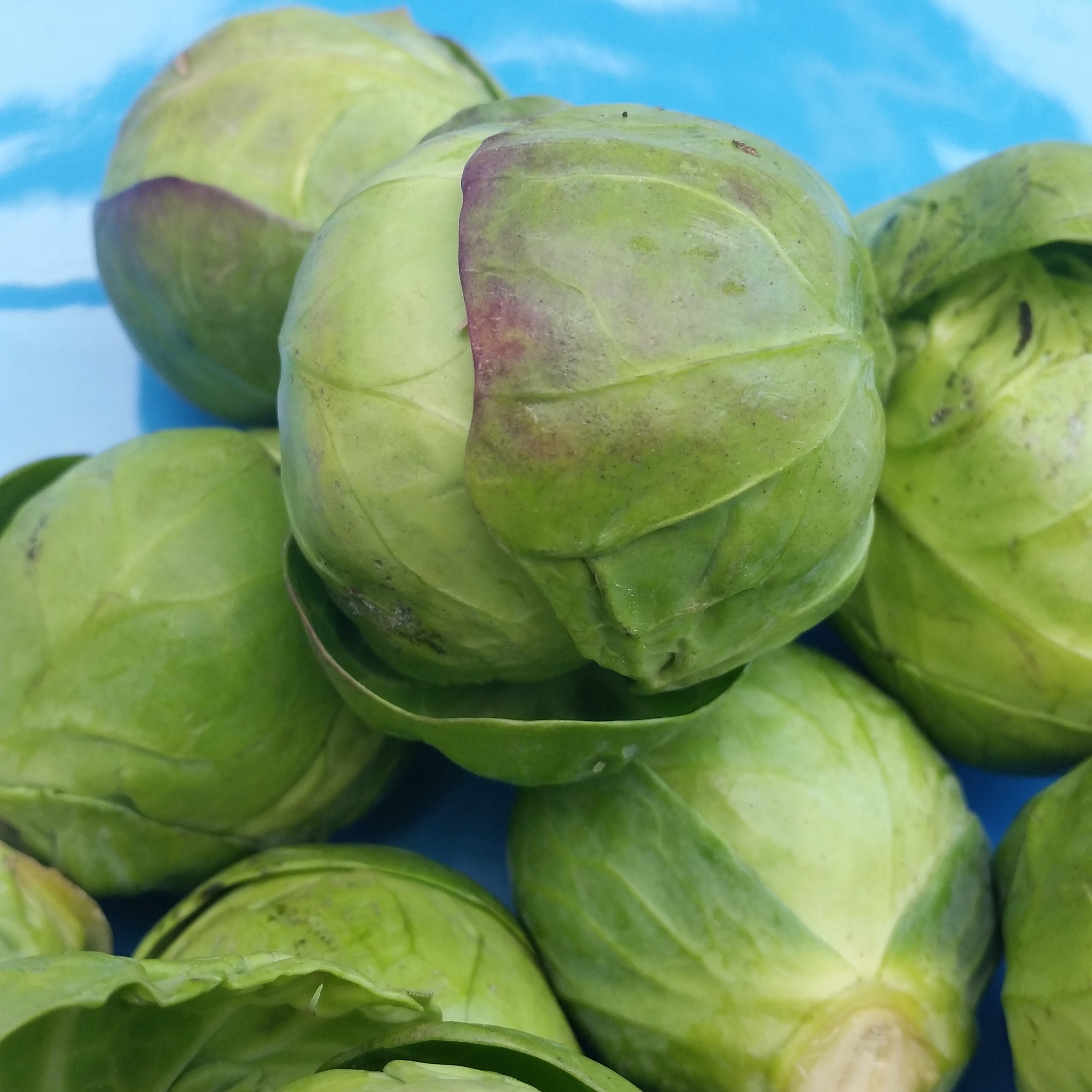
20150911_105814
Sometimes at the farmers market you can buy the complete stalk.  The sprouts will keep the best and for longer if stored on their stalks. These sprouts I purchased in Auckland are from Ohakune.

Brussels sprouts are a curious looking plant with mini cabbages growing up long tough stalks. Just like broad beans, the formed sprouts are picked from the bottom of the stems up, leaving the plant to continue growing. Brussels sprouts will not grow good “sprouts” in warm areas – they remain open and floppy and most likely will be infested with aphids.

Spicy Roasted Brussels Sprouts

This simple recipe makes the sometimes “dreaded” Brussels Sprouts moreish with the addition of honey, chilli sauce ( a mild sweet chilli sauce if encouraging children to eat them) and rice wine vinegar.
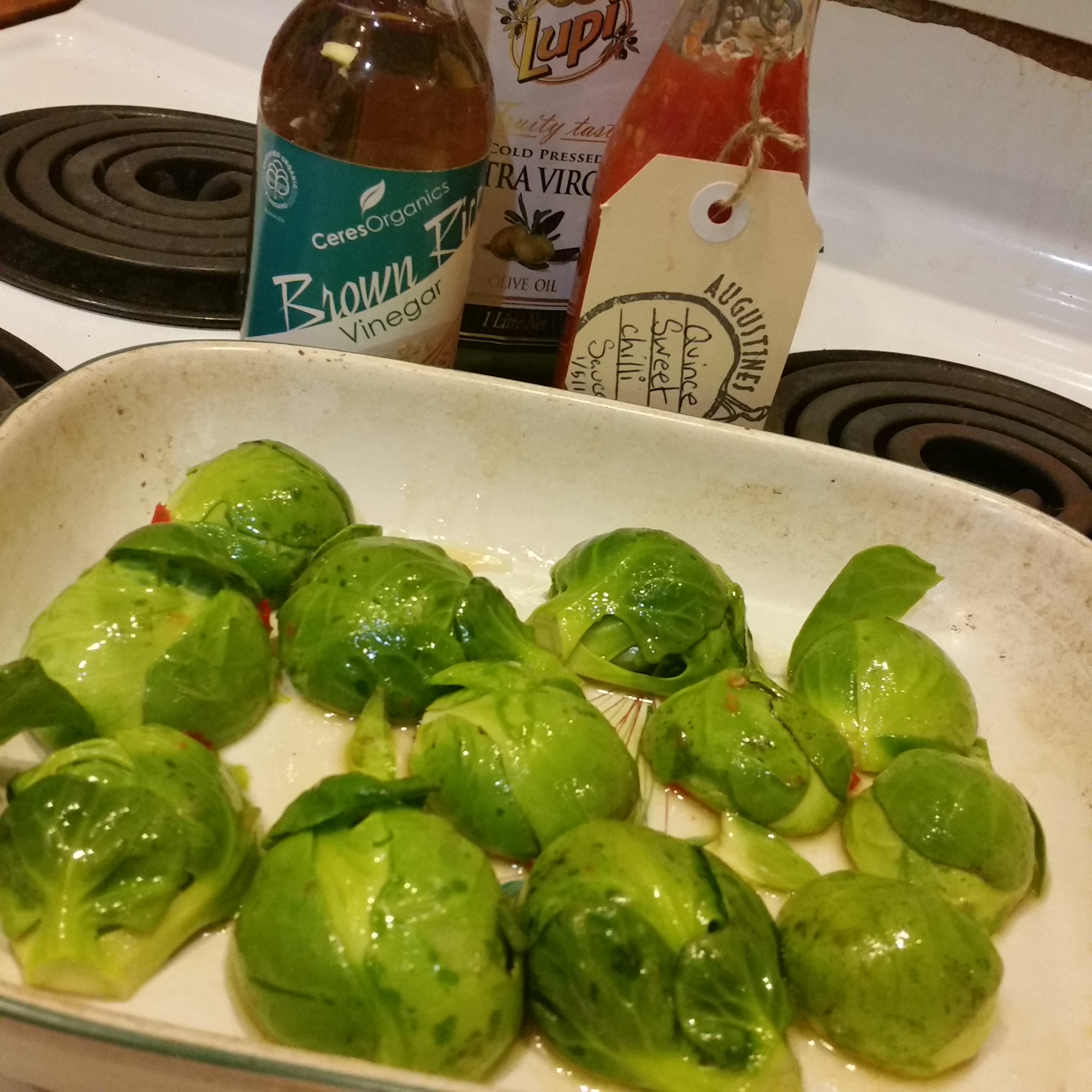
20150911_182427
The marinade is in the same proportions as most dressings, double the oil to the vinega. Use as many roasted sprouts as you wish using these proportions.

Consider doing what I do.  make more than what is needed for one meal, as they are delicious the next day when part of a salad, like a warm lentil salad.
This recipe uses approx 750 g of sprouts and preheat the oven to 180°C.
750g Brussels sprouts, ½ cup olive oil (or a mix of olive and rice bran oil), ¼ cup of brown rice vinegar (you can replace this with apple cider vinegar), 1 tbsp of honey, 2 tsp of chilli sauce (or to taste).
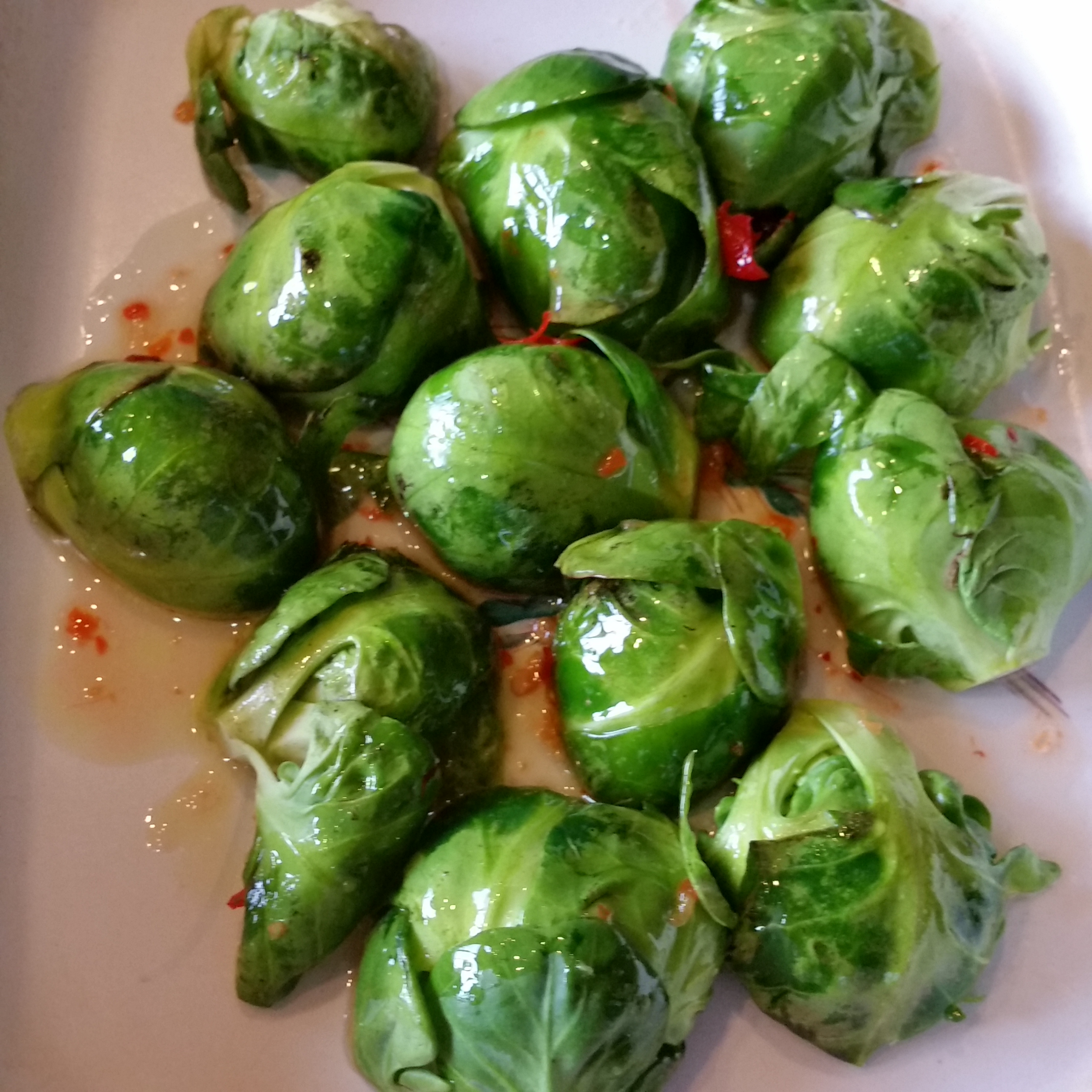
20150913_173857
Before cutting in half, remove any untidy stalk ends but careful not to cut too close to the sprout or you will lose the outer leaves.

Mix the marinade in a bowl, add the sprouts that have been cut in half and mix to cover the sprouts with the marinade. Lay the sprouts cut side down onto a large oven dish – big enough for every sprout to fit cut side down.
20150913_180847
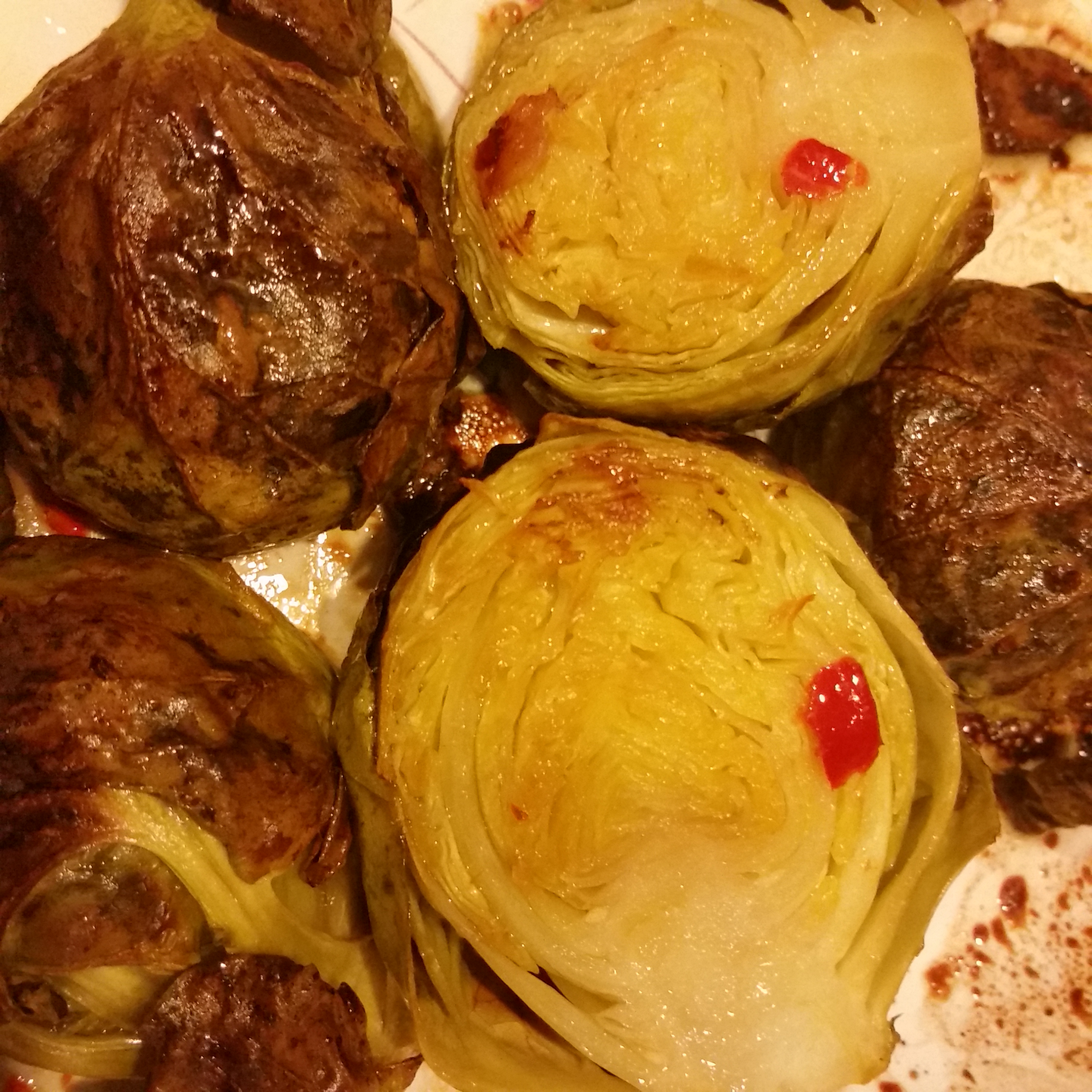
Tip any remaining marinade over the top of the sprouts and cook for around 20 minutes until the tops begin to crunch (even slightly char if you like that) and the underside has begun to caramelize.
20150911_190023
These were the first attempt and they ended up charred on the outside. They don’t look as good but when I read the original recipe again it was suggested to allow them to crisp on the outside. They did taste good and the crisp exterior leaves were a contrast to the soft interior of the sprouts.
pic20150921122349
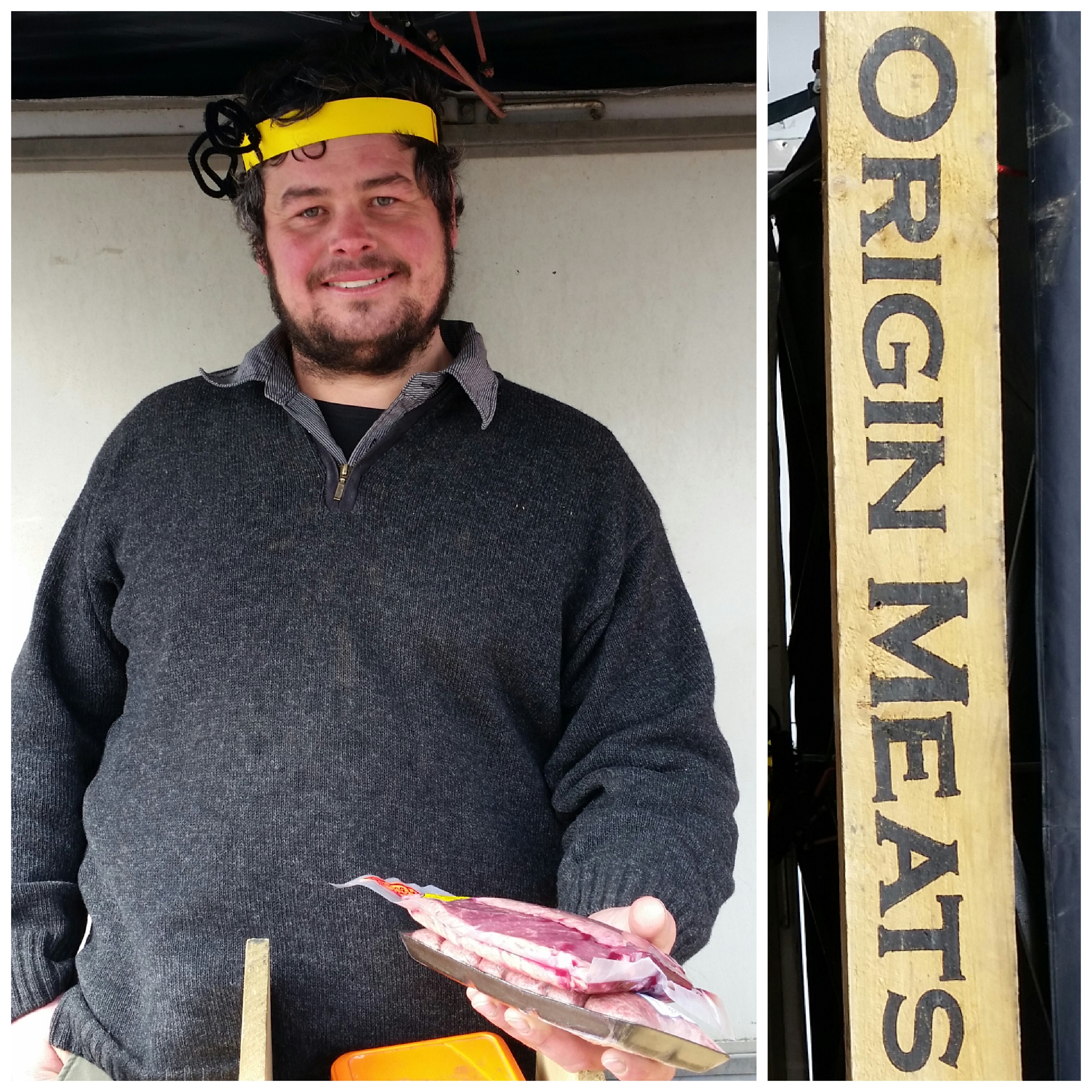
Stuart Kelly is a beef farmer south of Dunedin at Taieri Mouth.  Stuart’s commissioned neighbouring stallholder Havoc Pork to make beef sausages for him to sell. I just had to try some Origin  beef sausages.

One stop I like to make at the market is Origin Meats. With Stuart I get to talk to the farmer and he’s passionate about the product he produces and sells here every Saturday morning. He told me that by talking to his customers he’s gained a better understanding of what they are looking for and is now making decisions on cattle breeds based on feedback.
20150826_174038
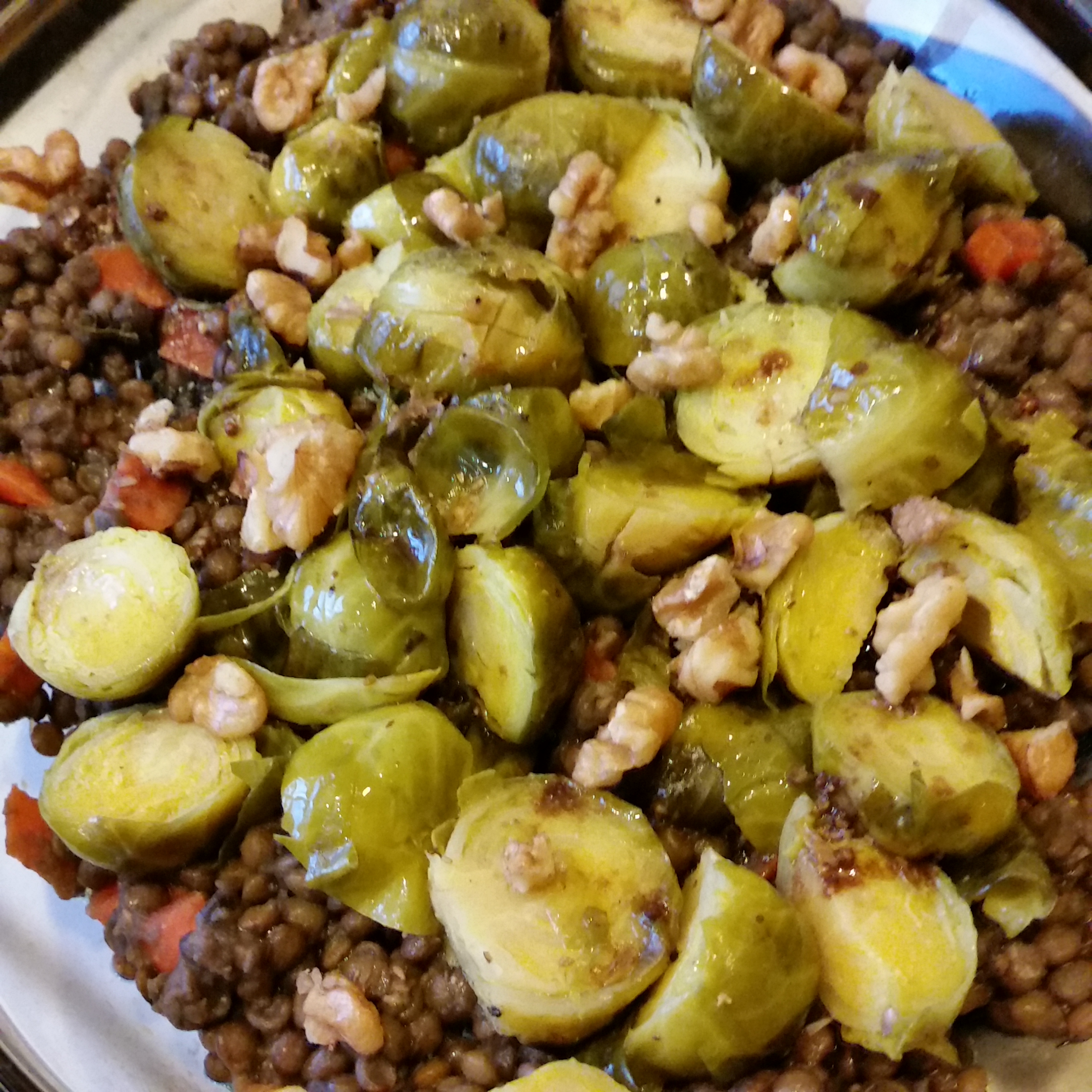
Brussels sprouts and lentil salad with its cabbage green and muddy coloured lentils doesnt look wildly exciting but it sure is a good taste combination. This salad is best served slightly warmed.

Green Lentil, Brussels Sprouts and Walnut Warm Salad
French green Puy lentils are the main ingredient for this ideal winter come spring salad and if you have leftover sprouts make sure you slightly warm them or at least have them at room temperature.  You can slice up the sprouts or keep them in halves. Make a robust dressing with lemon juice, oil, mustard and a touch of honey to flavour the lentils.  I like to add a little crushed preserved lemon to salt the lentils after they are cooked.  Alternatively keep aside a little of the marinade to put through the lentils as a dressing.  I also like to add some colour like roast carrots or preserved red pepper.  Walnuts are in season now and add a delicious crunch. If you have time baking the nuts for a few minutes in the oven with a little oil and a sprinkling of ground cumin will really add to the salad’s flavour.
pic20150921122118
Valda and Otto Muller (NZ Nut Products) from Cromwell grow varieties of walnuts that the European market wants. Luckily we also get an opportunity to buy them at the Farmers Market. I have talked about their walnuts in a previous post Afghans – an old fashioned favourite in July 2014.

Valda is a seasonal visitor to the market and I was so pleased she braved the cold so I could chat to her about their walnuts. One of my favourites is the variety called Vina.
With my hand luggage allowance I couldn’t take the beer or the beef back to Auckland but I did take a pack of Vina walnut pieces to enjoy in salads over spring. It’s best to keep shelled walnuts in the fridge if not using all at once.
You don’t need to miss out on these walnuts if you live in Auckland as Valda said she will be having a stall at La Cigale French Market in Parnell. She promised to let me know when so I can alert you on Jeannieskitchen Facebook page.
The Brussels sprout season will soon be coming to an end, or may be hard to come by where you live, but kale seems to be everywhere.  I experimented a little by using this marinade with thinly sliced Cavolo Nero kale (thick stems removed) and roasting it in the oven.
2015-09-24 15.12.56
Kale with just enough marinade to moisten and add gloss to leaves.

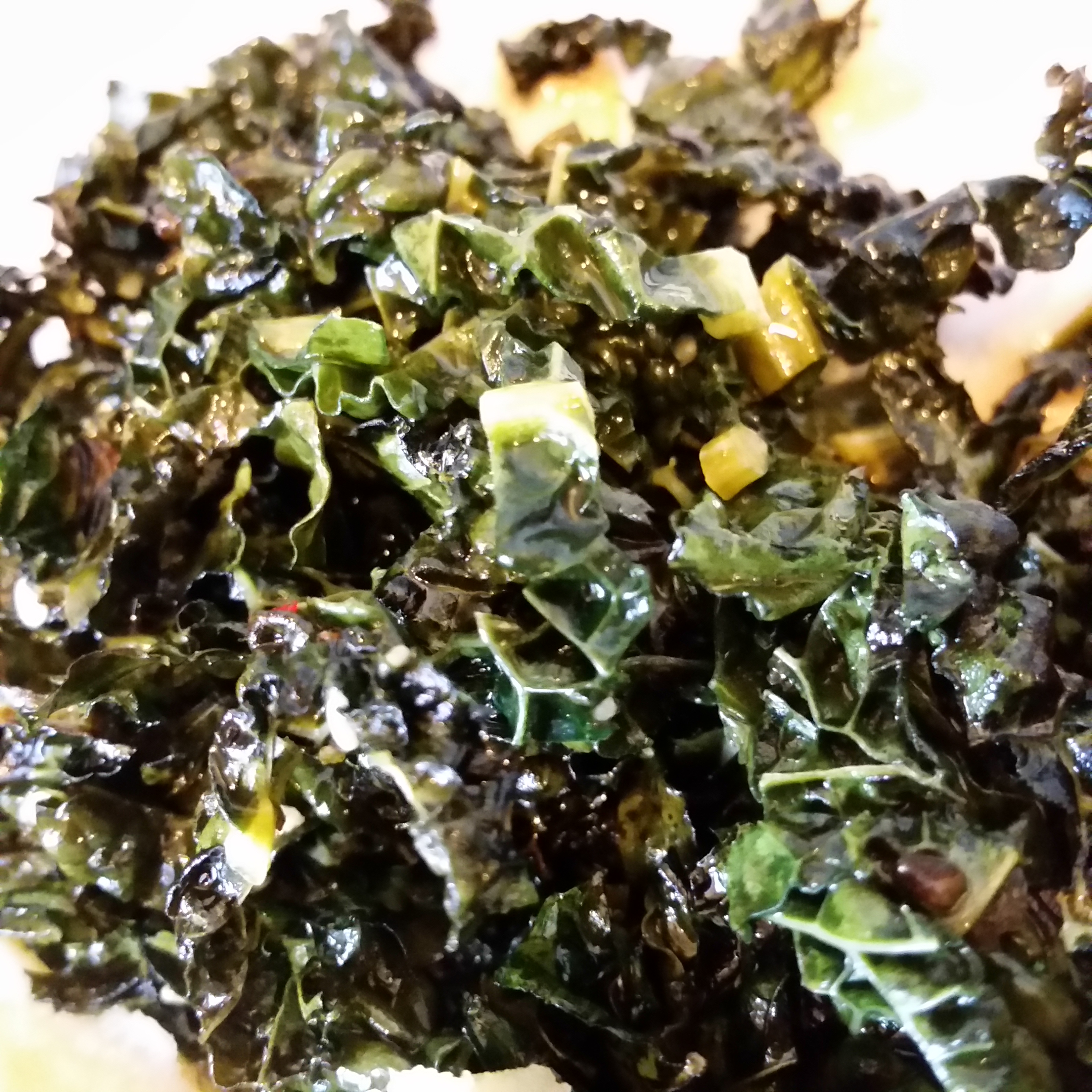
I ended up with kale chips only with more flavour. It looked better before cooking than after but I enjoyed the crispy chips on top and the slightly more chewy bits underneath. I also sprinkled in a little seaweed seasoning and this taste of the sea would be great with fish.
20150923_165427
The kale darkens a lot when it crisps up into crispy bits. I could have continued to make it all chip like or opt to cover with foil to have a softer greener outcome.
bee on brassica
Honey bee laden down with pollen on its legs after visiting some brassicas flowering atSanctuary Community Garden.

In early spring it’s delightful seeing the flowers start to bloom, but there is still not the number and variety that occurs in summer for the bees. Spring is also the time when we want to start working the garden – getting rid of those winter brassicas that are starting to flower.  Think about the bees before you clear fell.  Bumble and honey bees♥love brassica flowers.  That cabbage, Brussels sprout, rocket, brocoli, kale or mizuna can continue to provide food for the bees after we have finished harvesting them.  I see plenty of evidence of brassica pollen collection by bees at our community garden. In a warm spring day the place is literally buzzing.

2015-09-19 12.22.52
This young man of Waikouaiti Gardens was quite over being a bee sheltering in the van towards the end of the morning.

I was so busy talking with the brewers, the beef farmer and the walnut grower that I missed out on photographing Brussels sprouts…they had all gone.  We decided the bees were right to hide away from the last hurrah of winter in Dunedin – it was time for us to go and warm up by the fire.

Friday, 21 June 2013

Missing Midwinter in Dunedin

Tonight marks Midwinter Solstice, the shortest day of the year in the southern hemisphere.  In a more temperate Auckland midwinter passes by without too much fuss; but down south, midwinter is celebrated in style. Down south, there is something invigorating about a true winter's day... and the weather is always the first topic of conversation.

June also marks 6 months since we left Dunedin for Auckland, so it's timely that I reflect on the things I miss about Dunedin.  Here is a tour of my Dunedin favourites:
Jack Frost on stilts - a great and warm viewing place is up
in Bacchus Wine Bar & Restaurant - excellent food
and a wonderful selection of Central Otago wines
(Dunedin's first wine bar) Photo: Alan Dove Photography - Facebook  
The Midwinter Carnival held on the Saturday nearest to the shortest day has a  procession with hundreds of lanterns, many made by children, stilt walkers and performers in the city's centre...if the weather permits!

 Lighted Lanterns are a feature of the Midwinter Carnival in the Octagon,
St Paul's Cathedral in the background.  Photo: courtesy of Dunedin Tourism


It will be no surprise that my tour of Dunedin city is focused on food.  My choices have been influenced by my interest in the Victorian and Edwardian architecture of the city. 

Left Wedgewood tiles adorn the interior of the Railway Station;
centre; First Church  and right; Robbie Burns with St Pauls Cathedral in the Octagon.
Photos courtesy of Tourism Dunedin

Scotia Bar and Bistro

In a city that looks, sounds (busking bagpipers) and feels like Scotland (a wee bit chilly) it's most fitting that there is a restaurant called Scotia Bar and Bistro.
Victorian Terrace Houses built for the country landlords as
town houses.  Photo courtesy of Tourism Dunedin
I like the ambience and cosy feel as well as the good food. Enter this Victorian terrace house and you come to a bar with a wall of whisky and a warming fire.  You can choose to have a pre-dinner drink beside the warm fire.   The food by chef Andy Aitken has a touch of Scotland in the menu choice.  You can choose Haggis as an entree, which is surprisingly tasty and I had the best cooked Bluff oysters there.  Smaller, cheaper meals are on offer, which are ideal before going just up the road to the The Fortune - Otago and Southlands Professional Theatre.

Taste Nature - Organic shop and kitchen

Taste Nature or as known in Dunedin as The Organic Shop is situated in lower High Street opposite the Southern Cross Hotel.   Taste Nature ticks three boxes for me -
First it's got a large range of organically grown fruit and vegies, organic meats and a large selection of flours, grains, oils, dried goods, garden seeds, herbal products and spices.  I must say it's one of the best organic supply shops around.

I suggest going down to the back of the shop where large glass jars contain different dried fruits and find the crystallised ginger short sticks from the US, fill a small bag and enjoy the sugar coated punch of ginger.  I haven't found that ginger anywhere else.    Ginger is great eaten with dark chocolate and almonds...yum.
Photos from Taste Nature

Second, the kitchen that used to only do takeaway lunches now has seating so you can choose to have your lunch on site.   I love the casual atmosphere here, where you help yourself to a warming soup from a slow cooker for around $6 and another $1 for a thick slice of fresh baked bread, and pay later at the shop counter.
 The soup is made from ingredients from the shop and Mark the owner's garden at Waitati.  It's great soup, the best value in town with probably the best food values as well - and believe me soups are very desirable midwinter in Dunedin.

Thirdly, the building has a wonderful history dating back to the 1800's when Dunedin was a boom town. You can still see along the top of the building Bing Harris.  They were importers of the materials that supplied the many clothing manufacturers in the city. The new property developers have used old features really well, preserving the integrity of the old city for modern use.

Around the corner on Princes Street another lovely old building houses Nectar Espresso Cafe where you can get an excellent coffee.  It's fitted out in a modern style, with the good bones of the old building very much in evidence (and their pinwheel scones are yum but you have to be there before 11 because they usually sell out fast).

Hair Raiser Tours & City Walks

You always remember a city by the characters you meet.   Both Athol Parks of City Walks and Andrew Smith of Hair Raiser Ghost Tours certainly fit that bill.   Athol has a quiet manner and conveys insights into Dunedin's Victorian and Edwardian architecture with passion and knowledge.  Athol is usually dressed for the Dunedin climate in a weather proof jacket while the flamboyant Andrew wears a top hat and cape for his ghost stories and yarns about the mysterious characters of early Dunedin. 

Athol left and Andrew right; here they are celebrating the life of
a famous Dunedin walker Joe Scott with a walking race around
the Octagon during the Rugby World Cup 2011.
Andrew's Hair Raising tours operate every day and the ghost tour every night over winter at 6pm -a good way to work up an appetite before dinner.  Athol's tours run only by request over the winter but keep him in mind if you are in Dunedin from October on.

Everyday Gourmet

Everything I have ever eaten at Everyday Gourmet has been delicious.  The Supreme coffee is excellent and the service friendly.  Having been in business for 18 years it is a Dunedin institution.  Longevity in a cafe speaks of consistency and quality.   For under $10 you can get a tasty and seasonal salad and coffee. 

It is also a fabulous 'deli'. I have met many small producers at Farmer's markets and when asked if they have an outlet in Dunedin often the reply would be, "Yes, Everyday Gourmet sells our product".
Tempting edibles under those glass domes, and a wall that
runs the entire length of the shop is loaded with gourmet products
from  New Zealand and overseas.
 Everyday Gourmet can be found at the north end of George Street near Knox Church...its worth the walk.

Quadrant Gallery in The Quarter, Moray Place

Quadrant Gallery features contemporary jewellery, some made by owner David McLeod as well as stunning glass sculptures and ceramics.  I love the whimsical work of potter Peter Henderson.     I particularly like his coffee cups with animals.  The glaze is top quality and can take a beating in the dishwasher for years.  I worked in Quadrant for a short time and thought I had landed in paradise amongst so many lovely pieces of jewellery.  

A couple of examples of Peter Henderson's bowls
 The building where Quadrant is situated,  Bracken Court,  is owned by Ted Daniels. Ted an accomplished jeweller himself and loves buildings with character. When a recent fire destroyed this building, instead of pulling it down and replacing it with a modern one, he kept the stone facade and made a sympathetically designed modern building behind.  Next door to Quadrant is Cilantro Cafe where you can enjoy a coffee and admire lovely objects through the internal glass walls.


Quadrant is just one of many galleries and interesting shops in this 'quarter' of the old city.


Otago Farmers Market at the Railway Station

The farmers market has been operating for 12 years and is a regular Saturday morning routine for Dunedin foodies.  It's not only fresh produce on sale, its an opportunity to talk to producers directly, try new things and catch up with friends.


To find the Farmers Market you only have to spot the Railway
Station at the end of Stuart Street - the market is at the north end
of the station (left of picture) Photo: Tourism Dunedin
The highlight of my visit is catching up with Alison Lambert in the mobile kitchen.   Alison demonstrates easy ways of cooking with produce on sale at the market.  She is inspirational in the way she can produce something delicious out of a caravan with just a gas hob and small oven, sometimes in a southerly gale.  This means every recipe she makes is simple and anyone can make her recipes.  
You can watch Alison cook and have tastings every Saturday morning at the
market and if you are quick enough, grab a printed recipe sheet.  Its not only the recipes - its all the handy
tips that are so helpful.   Photo courtesy of Otago Farmers Market

From Otago Farmers Market Recipes I have chosen one especially for my brother Jamie whom I introduced  Cavolo Nero recently.  It is also known as Italian Kale or Black Cabbage. Jamie loves silverbeet and grows lots of it, but after tasting Cavolo Nero, the silverbeet may end up in the back row of his garden.
Like growing cabbage you need to give Cavolo Nero
plenty to eat and it will reward you with greens all winter

Caldo Verde – Portuguese Soup - a recipe from Alison Lambert


Alison's Caldo Verde uses a combination of greens including cabbage. To get a richer green colour and flavour, add some Cavolo Nero or silverbeet.  Remember, the darker the green, the better for you.


Serves 4
Ingredients
2 fat onions, finely chopped
4 cloves garlic, crushed
60ml olive oil
1 chorizo sausage or chilli salami (basecamp)
6 large potatoes
1.5 litres good vegetable or chicken stock
salt and freshly ground black pepper, to taste
2 bay leaves
large bunch of greens or cabbage

Method
Gently fry the onions and garlic in the olive oil until softened and translucent.
Chop the chorizo or chilli salami into small chunks and add to the pan with the onion.
Fry the onions and sausage for a few more minutes and then add the diced potatoes. They will absorb all the flavour from the sausage.
Add the stock, seasoning and bay leaves, and cook until the potatoes are soft.
Meanwhile, very finely chop the cabbage
When the potatoes are ready, mash them into the broth to make a thick base, add the greens/ cabbage to the simmering broth.
Add as much cabbage as the broth will support - if you want heavy soup add loads of greens, if lighter, add less.
Simmer for a few minutes. The soup will go the colour of jade.
Serve drizzle with extra virgin olive oil.
.............

You can buy some great sausages at the market to go into this perfect soup for a midwinter's weekend.  

So Dunedin, here's wishing you a clear fine evening for the Midwinter Carnival - wish I was there.


... oh and I haven't forgotten the Otago Peninsula.  I think that needs a posting all to itself. Next posting I will be mixing it with penguins and seals and having tea at a castle.  


Wednesday, 26 September 2012

Carrots - eat lots of them!

There is nothing quite like pulling a carrot straight from the garden, running it under the tap and eating the crunchy sweetness straight away.      But is it healthier to eat a carrot raw or cooked?  

I was surprised at the answer.  Carrots are more nutritious when cooked.   

A European study has revealed that 3% of the total beta-carotene content is released from raw carrots when consumed in raw pieces, juiced or pulped 21%, and cooking the carrot the accessibility was up to 27%. Addition of oil to the cooked pulp further increased the released amount to 39%.   It's to do with the ability of our digestive system to extract the beta-carotene from the tough cellular walls of the raw carrot. (Reference: European Journal of Clinical Nutrition 2002)   

That childhood favourite of bubble and squeak (parsnip and carrot mash) is the healthiest of all if you add olive oil.

Don't stop eating them raw - you do benefit from the vitamin C in carrots that is lost in cooking.   
The last of my autumn planted orange and purple carrots - their  "hairy legs"  show their age but they still taste sweet when cooked in the oven

This is good news for me because I love carrots cooked in the oven and Farmers Market chef Alison Lambert gave me an excellent way of cooking them.   I have a request for that recipe to go with the gremolata topping I gave in the parsley posting.  

Caramelised Carrots with Gremolata (lemon and parsley topping)

(serves 4)
2 Tbsp oil 
50g butter
600 g carrots (if small keep whole or cut in half lengthwise) *
(or a mix of carrots and parsnips)
Sea salt and freshly cracked pepper
2 sprigs of fresh thyme
4 cloves garlic, squashed lightly but kept unpeeled

Preheat the oven to 180C.  

Place your roasting dish into the oven to heat up so that when you add the carrots they immediately roast and colour up.

Put carrots, thyme, and garlic into bowl with oil, butter and season.  Toss and combine so that the carrots are coated in oil.

Toss into a preheated roasting tray and give it a light shake, cover with foil and bake for 30 minutes

Remove foil and continue to roast for a further 20 minutes or until tender and golden.

Toss  through or sprinkle on top the gremolata and serve immediately - you need to do this last minute so that when the vegetables are placed on the table they have that fresh fragrance of the parsley and lemon zest.  

You can also mix in some mint with the parsley which would work really well for some vegetables, e.g courgettes and asparagus.
Use this method of mixing the oil or dressing through and then tossing onto a preheated tray for all your vegetable roasting adventures and experiment with other herbs e.g. marjoram, rosemary
 * Good to know:   Carrots cooked without being sliced have one quarter more of the anti-cancer compound falcarinol than those that are chopped up first.  So limit the cutting up as much as you can until after they are cooked.   I saw on a television programme that it doesn't take any longer to cook a carrot whole than to cook it sliced.   


Purple carrots are not just a trendy addition to your carrot options.   They tend to have greater quantities of anti-oxidants and vitamins than the orange variety.   

The more intense the colour, the higher beta-carotene content the vegetable or fruit has and this includes greens like kale, silverbeet and broccoli.   I have purchased six orange cauliflowers called Cheddar Cheese so I imagine these contain beta-carotene.

My family used to joke that my son Francis was raised on raw carrots like a rabbit.  He was my only fussy eater but he would eat raw carrots.   Perhaps Francis knew a thing or two because carrots are so good for you.   Carrots help your eyesight, hair and nails,  regulate blood sugar, lower blood pressure, improve your ability to fight infection, assist in fighting liver and heart disease and for breast feeding mothers can enhance the quality of breast milk - so why wouldn't you eat lots of them!    

But there is a warning that you can overdose on vitamin A especially if you are consuming lots of carrot juice.   People have turned up in doctors surgeries looking quite orange with vitamin A poisoning.

My favourite juice combination is carrot, apple and ginger and is a great tonic to take if you are fighting infection or feel your body is under stress - and it tastes so good!

Jamie Oliver first introduced me to baking carrots and I often do carrots this way or mix with some other vegetables.  He uses thyme but I often use marjoram - you can use either or try tarragon as it's delicious with carrots.

Baked Carrots with Cumin, Marjoram and Chardonnay
(serves 4)
450g preferably whole new carrots scrubbed
1/2 tsp ground cumin* (you can add a little more as to your taste but cumin can easily dominate)
About 1 Tbsp of fresh marjoram or oregano or a couple of sprigs of thyme
Olive oil or I really like Avocado oil with lime for this - or you can use butter
1 glass chardonnay (or any leftover white wine and just as much as you have leftover)
Seasoning with salt and pepper

Jamie Oliver does this all in a large piece of foil.   I tend to use a covered casserole dish.  He mixes everything together on the foil (like I did in the bowl in the previous recipe), brings the sides up and then add the wine and scrunch the foil together to seal.

He cooks this for 45 minutes at 220C or longer for older bigger carrots.  I tend to cook them for 50 minutes at 180C fanbake in the casserole dish.   But it can fit in with whatever else is in the oven temperature wise - just the cooking time will vary.

I often cook potatoes and other vegetables this same way with some squashed garlic to make a one pot vegie meal for the two of us.    New potatoes are especially delicious.

The foil method is handy to use if you haven't got much room in your oven as it can be shaped to fit, or if you are somewhere where there are not enough oven dishes.  It's great to present for an outside meal as it looks rustic and casually thrown together...which is it.

* Its important that your ground spices are fresh so that the oils and fragrance remain.   You don't need to buy ground cumin you just need cumin seeds.   Put them into a small heavy pan on the stove top and toast until you can smell the fragrance - it will only take about ten seconds.  Now put the seeds into a spice grinder (a coffee grinder you keep for the purpose) or grind with a mortar and pestle.  Now smell the difference between the ground cumin you buy and the one you have prepared.

Carrot tops contain vitamin K but the carrot itself doesnt
I didnt know you could eat carrot tops.   I won't will be eating my aged carrot tops for vitamin K but I will try some baby carrot tops when they arrive.   I need to plant some carrots soon so that I can enjoy lots of carrots over the summer.    I do prefer to get my vitamin K from parsley (see my previous post on parsley).